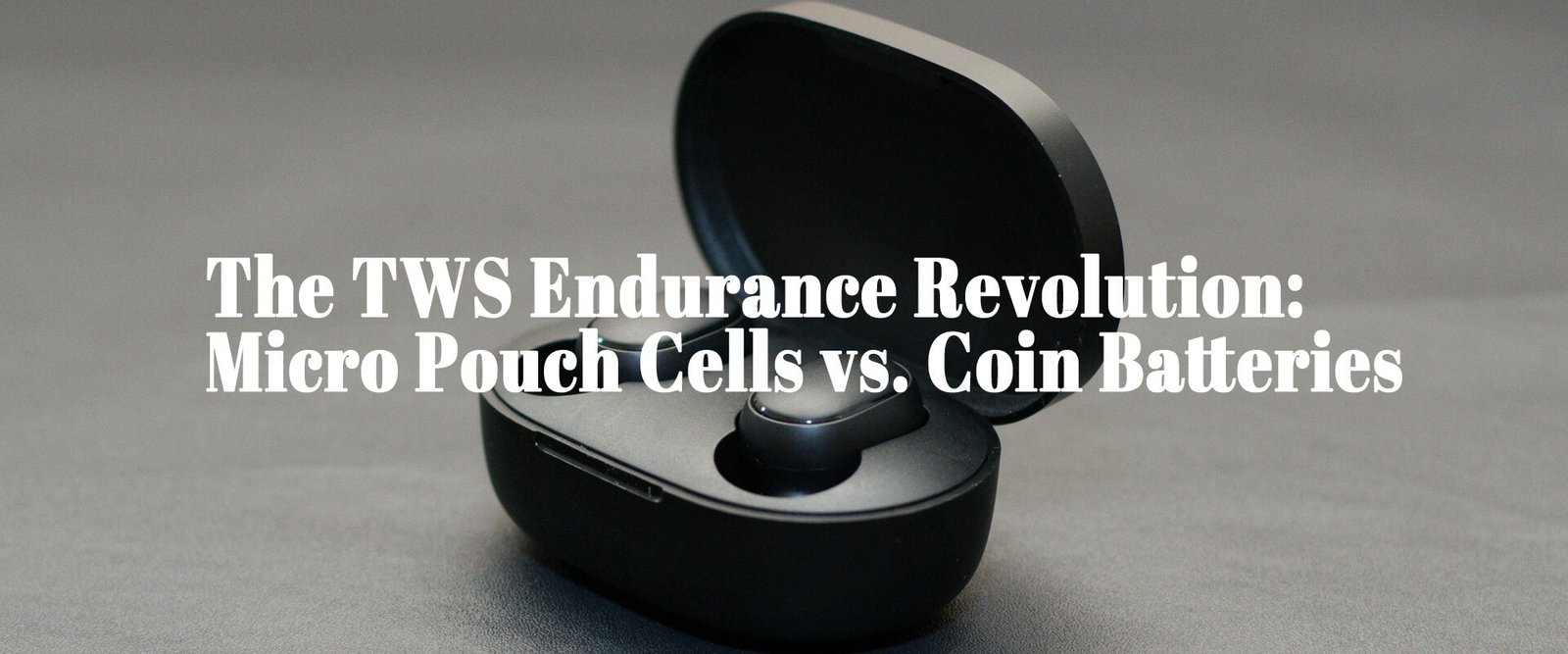
TWS Battery Revolution: Micro Pouch Cells vs. Coin Batteries
The True Wireless Stereo (TWS) earbud market has experienced a meteoric rise over the past five years, evolving from a niche audio accessory into an indispensable daily wearable. However, as B2B buyers, retailers, and distributors assess the next generation of smart audio products, a critical engineering bottleneck has emerged: the power paradox. Consumers demand power-hungry features—Active Noise Cancellation (ANC), spatial audio processing, multipoint Bluetooth 5.3 connectivity, and high-resolution codecs like LDAC. Yet, they simultaneously demand smaller, more ergonomic earbud designs.
The problem statement for hardware engineers is absolute: how do you deliver sustained, high-current power in an acoustic cavity measured in cubic millimeters? Historically, the industry relied on rechargeable lithium-ion coin cells (such as the LIR1054 or LIR1254). While reliable, these rigid, metal-cased batteries are rapidly hitting a thermodynamic and spatial ceiling. To power the next generation of TWS devices, the industry is undergoing a silent revolution, transitioning toward highly customized, ultra-high-density micro pouch cells.
For distributors and retailers, understanding this shift in battery chemistry and mechanics is no longer optional. It is the defining factor that separates a premium, long-lasting TWS product from a budget device plagued by audio dropouts and premature battery death.
Deconstructing the Power Source: The Chemistry and Mechanics of TWS Batteries
To understand why micro pouch cells are taking over, we must dive into the electrochemical and mechanical realities of battery design at the micro-scale.
1. The Spatial Inefficiency of Rigid Coin Cells:
Traditional rechargeable coin cells utilize a rigid stainless-steel can. Inside this can, the electrodes (anode, separator, and cathode) are wound into a circular “jelly-roll.” This architecture presents two massive engineering flaws for TWS earbuds. First, the steel can itself is electrochemically inactive “dead weight” and consumes valuable volume. Second, placing a rigid cylinder inside an ergonomically curved, teardrop-shaped earbud chassis creates “dead space”—voids of air that cannot be utilized for energy storage.
2. The Micro Pouch Cell Advantage:
Micro pouch cells discard the rigid metal can in favor of a flexible Aluminum Laminated Film (ALF). Instead of a wound jelly-roll, the internal electrodes are typically Z-stacked. This soft-pack architecture allows the battery to be manufactured in virtually any custom shape—curved, semi-circular, or asymmetric. By perfectly contouring to the internal acoustic cavity of the earbud, pouch cells maximize the volumetric energy density (Wh/L). For engineers looking to overcome strict spatial constraints while maximizing capacity, integrating a custom li-po battery offers unparalleled geometric flexibility and active material payload.
3. Cell Chemistry: LCO vs. NMC in Micro-Scale:
In the TWS sector, Lithium Cobalt Oxide (LCO) chemistry reigns supreme over Nickel Manganese Cobalt (NMC) or Lithium Iron Phosphate (LFP). LCO boasts an exceptionally high tapped density, allowing engineers to pack more active material into a microscopic volume. Furthermore, modern micro LCO cells are being pushed to higher voltages (High-Voltage Lithium, or LiHV), charging up to 4.35V or 4.40V. This elevated voltage plateau extracts significantly more energy from the same physical footprint.
4. Internal Resistance and the SEI Layer:
TWS earbuds do not draw power linearly. When ANC is activated, or when the Bluetooth radio transmits a data burst, the earbud demands a sudden, sharp spike in current. If a battery has high Internal Resistance (IR), this current spike causes a severe voltage sag (V=I×R). Traditional coin cells often suffer from high IR due to their constrained tab designs. Micro pouch cells, however, utilize wider current collector tabs and optimized electrolyte formulations that stabilize the Solid Electrolyte Interphase (SEI) layer on the anode. This minimizes the DC Internal Resistance (DCIR), allowing the battery to deliver high-current pulses without the voltage dropping below the audio chipset’s critical shut-off threshold.
Comparative Analysis of TWS Battery Architectures
The following high-density data table illustrates the performance trade-offs between legacy coin cells and modern micro pouch architectures when evaluated for premium TWS applications.
Table 1: TWS Battery Architecture Specification Comparison
| Specification / Metric | Traditional Coin Cell (LIR Series) | Standard Micro Pouch Cell | High-Density Custom Micro Pouch (LCO) |
|---|---|---|---|
| Volumetric Energy Density (Wh/L) | 300 – 400 Wh/L | 450 – 550 Wh/L | 600 – 750+ Wh/L |
| Internal Resistance (ACIR @ 1kHz) | > 150 mΩ (High voltage sag) | < 80 mΩ | < 50 mΩ (Highly stable voltage) |
| Form Factor & Spatial Efficiency | Rigid Cylinder (Creates dead space) | Standard Rectangular | Ultimate (Curved, bespoke geometry) |
| Self-Discharge Rate (Monthly) | 2.0% – 5.0% | 1.0% – 3.0% | < 1.5% (Excellent shelf life) |
| High-Pulse Load Capability (ANC) | Poor (Prone to audio dropouts) | Good | Excellent (Sustains high-res DSPs) |
(Note: Data reflects typical industry averages for cells under 100mAh utilized in wearable audio electronics).
Lessons Learned from the Factory Floor: The ANC Voltage Sag Crisis
To truly grasp the operational impact of these electrochemical differences, we can examine a failure analysis from a Tier-1 audio brand attempting to launch their first ANC-enabled TWS earbud.
The Scenario:
The OEM designed a beautifully compact earbud. To save on R&D tooling costs, they opted for an off-the-shelf LIR1054 rechargeable coin cell (nominally 40mAh). During basic Bluetooth playback testing, the earbuds performed flawlessly, achieving 4 hours of battery life.
The Problem:
When the earbuds moved into real-world beta testing, disaster struck. Users reported that when they walked into noisy environments (like a subway) and the adaptive ANC algorithm kicked into maximum overdrive, the earbuds would abruptly disconnect or reboot, despite the battery indicator showing 40% remaining.
Root Cause Analysis:
The engineering team placed the earbuds under an oscilloscope. The adaptive ANC required the Digital Signal Processor (DSP) to generate anti-noise waveforms instantaneously, drawing a sudden 80mA pulse from the battery.
The LIR1054 coin cell had an internal resistance of nearly 200 mΩ. When the 80mA pulse hit, the high internal resistance caused a massive, instantaneous voltage droop. The cell voltage plummeted from a healthy 3.7V down to 3.1V for a fraction of a second. This sudden drop breached the Bluetooth System-on-Chip’s (SoC) low-voltage cut-off threshold, triggering an emergency hardware reset to prevent data corruption.
The Engineering Solution:
The OEM was forced to halt production and redesign the acoustic cavity. They transitioned to a custom-shaped 45mAh micro Li-Po pouch cell. Because the pouch cell utilized a stacked electrode design and specialized low-impedance electrolyte, its internal resistance was measured at a mere 45 mΩ. Under the exact same 80mA ANC pulse, the voltage barely sagged, maintaining a stable 3.6V. The audio dropouts were completely eliminated, and the brand successfully launched a critically acclaimed product.
The Crucial Synergy: Batteries and Charging Accessories
For B2B buyers and wholesalers like those sourcing from Wandkey.com, it is vital to understand that a premium TWS battery does not operate in a vacuum. The lifespan of these high-density micro pouch cells is inextricably linked to the quality of the charging ecosystem.
TWS earbuds undergo severe “micro-cycling.” Every time a user places the earbuds back into the charging case, they are subjected to a charge cycle, often sitting at a highly oxidative 100% State of Charge (SoC). If the charging case itself is powered by a subpar wall charger or a low-quality USB-C cable with high resistance, voltage fluctuations can stress the case’s Power Management IC (PMIC).
High-quality charging accessories—such as certified PD (Power Delivery) wall chargers and premium, low-resistance Type-C cables—ensure a clean, perfectly regulated 5V power delivery to the TWS case. This clean power allows the case’s internal circuitry to execute precise Constant-Current/Constant-Voltage (CC/CV) charging profiles for the earbuds. By bundling premium TWS devices with equally premium charging accessories, retailers ensure that the delicate SEI layers within the micro batteries are not degraded by thermal stress or voltage spikes, drastically extending the overall lifespan of the product and reducing warranty returns.
Frequently Asked Questions (FAQ) for B2B Buyers
Q: Why do TWS batteries seem to degrade significantly after 12 to 18 months?
A: TWS batteries suffer from extreme micro-cycling. Because users constantly return them to the case, they are frequently trickle-charged and held at 100% SoC. This high-voltage state accelerates the oxidation of the liquid electrolyte and thickens the SEI layer, leading to an irreversible increase in internal resistance and a loss of capacity over 18 months.
Q: Are micro pouch cells prone to swelling inside the earbud?
A: All lithium-based batteries can generate trace gases as they age. However, premium micro pouch cells use proprietary anti-gassing electrolyte additives. Furthermore, reputable TWS engineers design the internal plastic chassis with a calculated 5% to 8% volumetric expansion gap to safely accommodate End-of-Life (EoL) swelling without cracking the earbud casing.
Q: Does fast charging damage these tiny batteries?
A: It can, if not managed correctly. Pushing high C-rates (fast charging) into a micro cell generates heat, which degrades chemistry. Premium TWS brands mitigate this by using advanced PMICs that monitor temperature and dynamically throttle the charge current, ensuring the battery charges quickly from 0% to 50%, but slows down significantly to protect the cell chemistry as it approaches 100%.
Actionable Advice for Procurement Managers and Distributors
As the TWS market matures, consumers are becoming highly educated about battery longevity and performance. For procurement managers, retailers, and distributors, evaluating the power architecture of a TWS product is critical for protecting your brand reputation and minimizing RMA rates.
- Look Beyond the mAh Rating: Do not source a TWS product based solely on its milliamp-hour capacity. Ask the OEM about the Volumetric Energy Density (Wh/L) and the form factor. A custom-shaped pouch cell indicates a higher level of engineering investment than a generic coin cell.
- Inquire About Internal Resistance (DCIR): If you are sourcing ANC-enabled earbuds, demand to see the DCIR specifications of the internal batteries. High resistance will inevitably lead to voltage sag, audio dropouts, and poor customer reviews.
- Verify UN38.3 and IEC 62133 Certifications: Micro pouch cells require meticulous manufacturing to ensure the Aluminum Laminated Film is sealed perfectly. Ensure the batteries inside the TWS devices have passed rigorous international safety testing (like IEC 62133) to guarantee they are safe for in-ear use.
- Promote Ecosystem Synergy: Educate your retail partners and end-consumers that a high-end TWS device deserves high-end charging gear. Cross-sell premium TWS products with high-quality, certified charging cables and adapters (like those available through Wandkey’s wholesale network) to ensure optimal battery health and a flawless user experience.
By understanding the micro-mechanics of TWS power systems, B2B buyers can confidently navigate the market, selecting products that deliver the sustained, high-fidelity performance that today’s sophisticated audio consumers demand.
About Wandkey
Wandkey Electronic is a professional OEM/ODM manufacturer specializing in custom USB cables and fast-charging accessories. Our products are certified by CE, RoHS, FCC, and ETL, and trusted by brands and device makers in over 30 countries including the US, Europe, Japan, South Korea, and the Middle East. Explore the world of smart connectivity and charging solutions with Wandkey.
- Eamil: info@wandkey.com

Carl at Wandkey
Carl is the CMO at Wandkey, with 10+ years of experience in mobile accessories. He shares pratical insights to help global buyers choose the right USB-C cables and charging solutions.